ENGINEERING HISTORY
Building The Eagle's Nest:
The Kehlsteinhaus Road
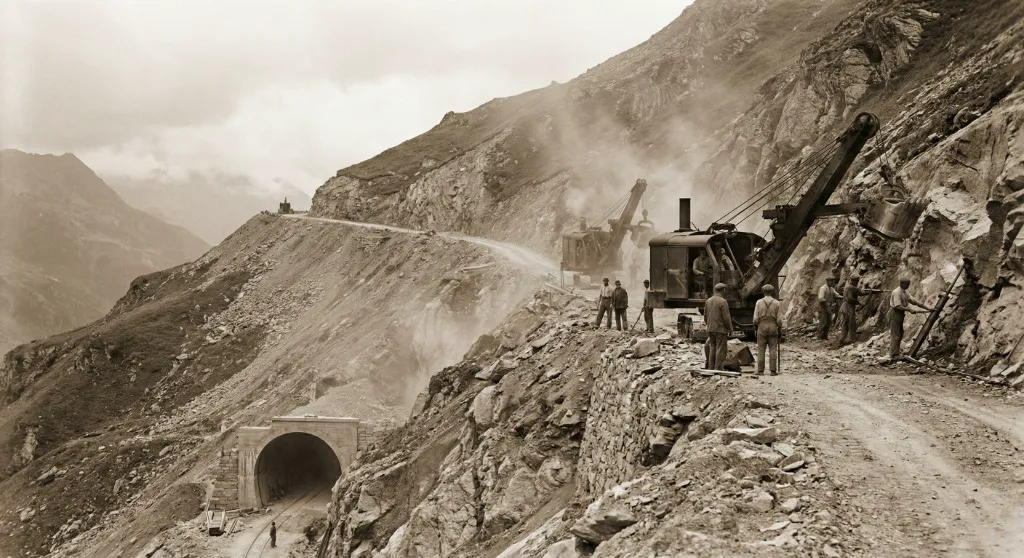
Built in just 13 months, the road to the Eagle's Nest (Kehlsteinhaus) is considered one of the greatest feats of alpine road construction. Discover the secrets of the brass elevator, the five tunnels, and the Italian stonemasons who built it.
Construction Time
13 Months (Record)
Cost
30M RM (~€150M today)
Elevation
1,834 meters
Workforce
3,500+ Workers
A Gift That Wasn't
The Kehlsteinhaus was commissioned by Martin Bormann as a 50th birthday gift for Adolf Hitler in 1939. However, the "gift" was more about Bormann demonstrating his ability to conquer nature than providing a home. Hitler visited the house fewer than 20 times, fearing the thin safety margins of the elevator winch and the exposed road.
The construction was a brutish, rapid project. Over 3,500 workers, largely skilled Italian stonemasons and German specialists, worked around the clock through the harsh winner of 1937-1938. The road rises 700 meters in just 6.5 kilometers with only one switchback—a distinct engineering choice to allow faster ascents for official convoys.
Technical Secrets
3 Engineering Marvels
The Brass Elevator
Deep inside the mountain lies a 124-meter vertical shaft lined with marble. A brass-paneled elevator ascends this shaft in just 41 seconds.
Heated Stones
To prevent the VIPs from feeling the mountain chill, the 124m entrance tunnel was originally heated by a warm air system. Even the marble floor of the great hall had underfloor heating—luxury tech for 1938.
The U-Boat Engine
Power outages were unacceptable. Bormann installed a massive MAN diesel submarine engine in a lower cavern as an emergency generator. It is still there today and fully functional.
Visiting Today
When you take Bus 849, you are driving on the original 1938 pavement in many sections. The five tunnels remain largely unchanged. As you enter the marble tunnel to the elevator, notice the temperature drop—the heating system is long disabled, but the sheer scale of the excavation remains humbling.