To the naked eye, Neuschwanstein Castle looks like a relic from the Middle Ages—a fortress built for knights and dragons. But this is actually a massive architectural magic trick. This "medieval" castle is technically younger than the invention of the telephone, the elevator, and the Brooklyn Bridge.
King Ludwig the Second, the man behind the vision, was a walking paradox. He was obsessed with the look of the thirteenth century, but he absolutely hated the discomfort of it. He wanted the romance of the past with the convenience of the future. So, hidden behind those ancient-looking tapestries and stone walls is actually a high-tech "smart home" that was decades ahead of its time.
If you visited a real medieval castle, you would be freezing. But not here. Ludwig installed a cutting-edge central heating system known as a calorifère. Pipes channeled hot air from a central furnace to the various rooms, ensuring the King never had to shiver in his silk robes, and it even had humidity control to protect the artwork.
The luxury didn't stop at heating. While most of his subjects were still using outhouses, Ludwig’s private suite featured an automatic flushing toilet connected to a running water system. In fact, the castle had running water on every single floor, with the royal kitchen equipped with both hot and cold taps—a rarity for the 1880s. In his bedroom, water flowed from a silver-plated faucet shaped like a swan, blending art with advanced plumbing.
Ludwig was a recluse who famously coined the phrase, "I wish to remain an eternal enigma to myself and others". To maintain his isolation, he used technology to manage his staff without ever having to see them. He installed an electric bell system powered by batteries to summon servants from a distance. For dining, he utilized a mechanical dumbwaiter lift. His meals were cooked in the ground-floor kitchen and hoisted up four stories to the dining room, ensuring the food arrived hot and the servants remained invisible.
And perhaps most surprisingly for a "medieval" fortress: it had a telephone. A line connected Neuschwanstein to the neighboring castle, allowing the King to communicate electronically in an era when that was considered almost magical.
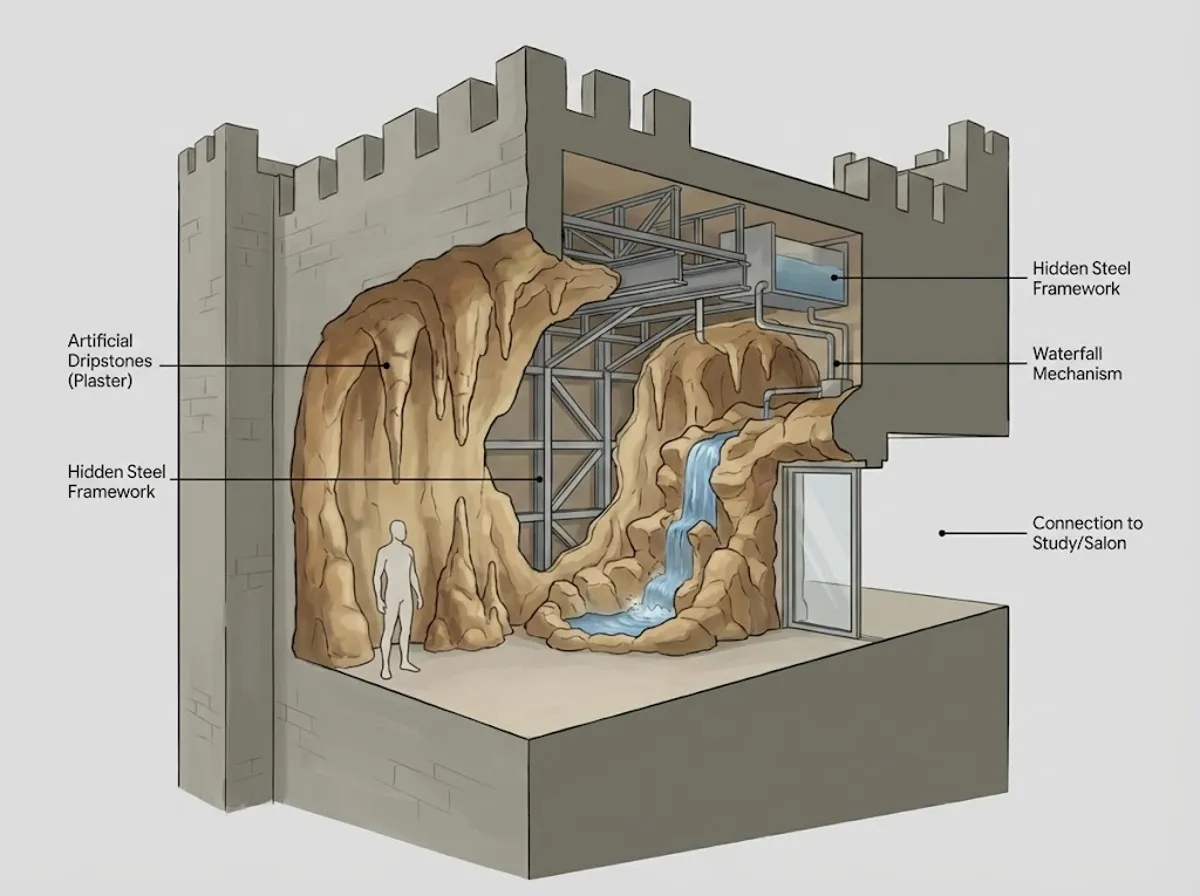
The biggest secret of Neuschwanstein, however, is structural. It isn't just a pile of stones; it is a skyscraper in disguise. The Throne Room required such massive open space that it couldn't be supported by traditional masonry. Instead, it relies on a massive, encased steel skeleton—a construction technique that paved the way for modern high-rises. Even the famous "Grotto"—the artificial cave on the third floor—is a triumph of industrial stagecraft. It isn't rock at all, but plaster sculpted over a steel framework, originally complete with a functioning waterfall and colored lighting.
Neuschwanstein is often called the "Castle of the Fairy Tale King." But when you strip away the romance, you find something perhaps even more impressive: a nineteenth-century machine built to power one man’s fantasy.