Neuschwanstein & Disney:
The Real Sleeping Beauty Castle
For millions who have never stepped foot in Germany, Neuschwanstein is still instantly recognizable. It is the architectural DNA behind the most famous logo in the entertainment world.
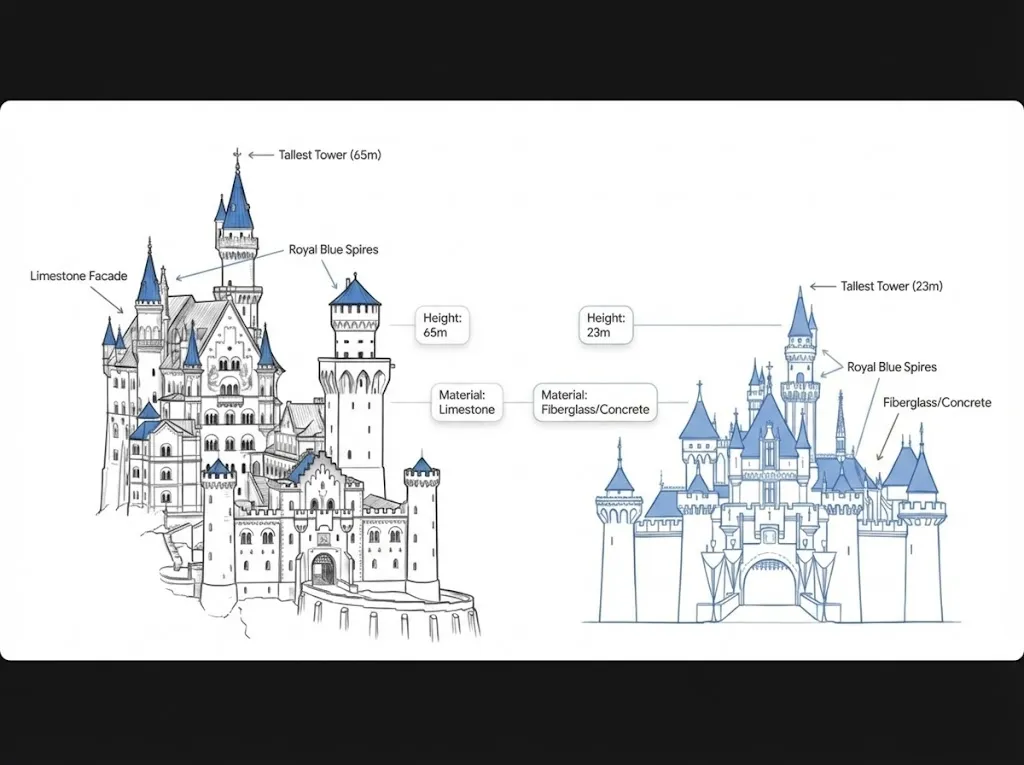
Original
65 meters tall
Disney Copy
23 meters tall
Material
Limestone vs. Fiberglass
Audio Guide: The Disney Connection
Listen to the full story of how a Bavarian King inspired the most famous castle in the world.
Architectural DNA
Separated at Birth: The Differences
Neuschwanstein (The Original)
Height: 65 meters (Tallest Tower)
Material: Brick encased in thick limestone. Built to last centuries.
Purpose: A solitary retreat for one man (King Ludwig II).
Disneyland (The Copy)
Height: 23 meters. It uses "forced perspective" to look taller.
Material: Fiberglass and concrete (earthquake resistant).
Purpose: To handle 50,000+ tourists daily.
Did You Know?
The "Disney look" has become so defining that tourists often describe Neuschwanstein as looking "like a Disney movie," failing to realize that the castle is the original and the movie is the copy.
Bavaria's Legacy
The Ultimate Irony
Neuschwanstein ends on a note of profound irony. Ludwig died fearing he had ruined his kingdom, a "failure" who could not pay his bills. Yet, the entrance fees from the millions of visitors who have since flocked to his "private refuge" have paid off his debts a thousand times over.
The "Mad King" turned out to be Bavaria's greatest long-term investor.
Audio Transcript
For millions of people who have never stepped foot in Germany, Neuschwanstein Castle is still instantly recognizable. That is because it serves as the architectural DNA behind the most famous logo in the entertainment world. In 1935, Walt Disney visited Bavaria and was captivated by the castle's silhouette. When it came time to design Sleeping Beauty Castle for the opening of Disneyland in 1955, the influence was undeniable. The slender blue turrets, the stark white limestone façade, and the romantic positioning on a rugged hill all found their way from the Alps to Anaheim.
Surprisingly, the two castles share more than just a visual likeness; they were both born from the world of theater. Neuschwanstein was not originally designed by a practical architect, but by a scenic stage designer named Christian Jank. His sketches were high romantic fantasy intended to look like a set for a Wagner opera. In this sense, King Ludwig employed "Imagineers" nearly a century before Disney did. Both structures utilize "forced perspective"—visual tricks to make towers appear taller and more imposing than they actually are.
While the silhouettes are similar, the reality of the two structures is vastly different. Neuschwanstein is a genuine fortress of brick encased in heavy limestone, built to survive centuries. In contrast, the Disney castle is a masterclass in modern set dressing, constructed from fiberglass and concrete to meet earthquake codes. Furthermore, while Disney’s castle was designed to handle thousands of tourists daily, Neuschwanstein was built for the solitude of just one man—a design flaw that becomes apparent today as 1.5 million visitors try to squeeze through its halls every year.
The connection between the two has become so strong that it has created a strange historical loop. Tour guides at Neuschwanstein frequently report that tourists describe the nineteenth-century King’s home as looking "just like a Disney movie," failing to realize that the castle is the original, and the movie is the copy.